Presa Canario in Australia: the law, and why we don’t list them

Presa Canarios can’t be brought into Australia, and we don’t list them or their crosses in any state or territory. The rest depends on your state:
- Keeping one. Strict rules apply in Victoria, New South Wales, South Australia and Western Australia.
- Advertising one. New South Wales, South Australia and Western Australia make it an offence.
- Tasmania. The rules apply only once a dog has been declared.
- ACT and NT. The ACT Government says there are no restricted breeds in the ACT. In the Northern Territory, check your council’s by-laws as well as the territory’s animal welfare law.
- Crosses. It depends on the state. In Western Australia, any mix that includes a restricted breed counts.
The short version
- Presa Canarios can’t be brought into Australia. They’re one of five restricted dog breeds.
- Selling or giving one away is an offence in Victoria, New South Wales, Queensland, South Australia and Western Australia. Queensland also makes owning one an offence, with some exceptions. See the law in your state or territory.
- Advertising one is an offence in New South Wales, South Australia and Western Australia.
- Tasmania’s rules apply only once a dog has been declared. The ACT Government says the ACT has no restricted breeds. In the Northern Territory, check your council’s by-laws.
- Whether a cross counts depends on the state. In Western Australia, any mix that includes a restricted breed counts. See how a dog or a cross is identified.
- Pet Sales Australia doesn’t allow Presa Canarios, or their crosses, to be listed in any state or territory. If you see one advertised, don’t pay anything.
- Already own one, or a cross? Giving one away can be an offence too. Check before you do anything.
- This page is general information, not legal advice. We read every source on 11 October 2026. For your own dog, ask your council or a lawyer.
What is a Presa Canario?
The Presa Canario is a mastiff-type dog, and its breed standard gives its origin as Spain. It’s also called the Perro de Presa Canario. The Commonwealth’s import list uses both names.
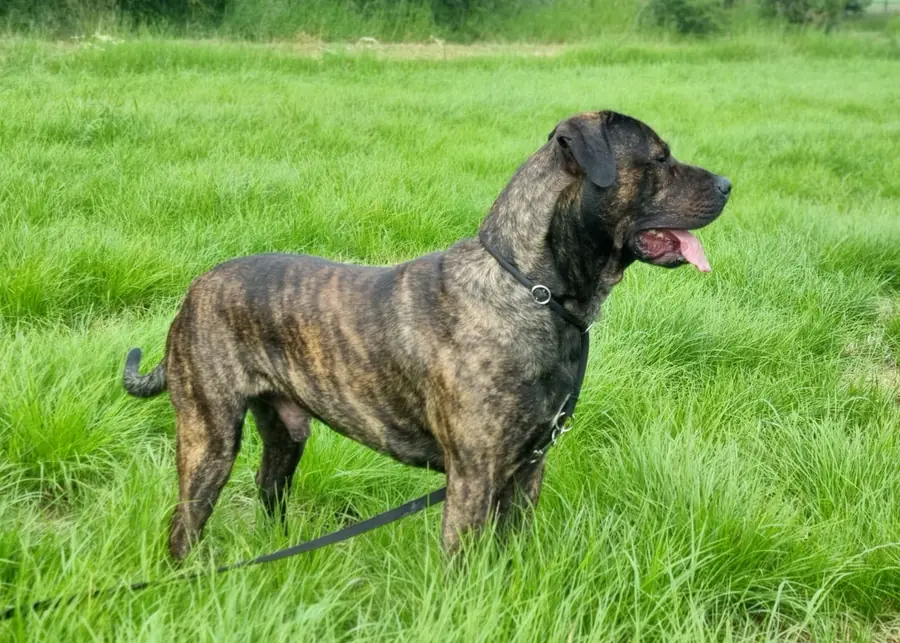
Not for sale. Photo: MalleMientje, CC BY 4.0, cropped.

- An international body recognises it. The Fédération Cynologique Internationale (FCI) lists it as breed number 346, in its section for mastiff-type breeds. Its page says the FCI accepted the breed provisionally on 4 June 2001, and definitively on 4 July 2011.
- The FCI standard. The FCI’s breed standard (PDF), published on 23 September 2023, describes a medium-sized, robust dog with a black mask and a short, coarse coat in brindle, fawn or black. It puts males at 61 to 66 cm at the withers and 45 to 57 kg, and females at 57 to 62 cm and 40 to 50 kg.
- Where it’s from. The standard says the breed comes from Tenerife and Gran Canaria, in the Canary Islands, and gives its use as a guard dog for protecting cattle.
A breed standard describes the ideal show dog. It doesn’t decide what any one dog is in law.
We’ve left out the standard’s lines on temperament. Pet Sales Australia doesn’t describe any dog as dangerous or safe because of its breed.
Does Dogs Australia recognise the Presa Canario?
It has no breed standard for one. Its breed standards pages list 227 standards across seven groups, and none is for the Presa Canario, under any name. Its recognised breed listing doesn’t name the breed either.
Two Dogs Australia documents point the other way:
- Its registration rules (PDF). They say Dogs Australia recognises all breeds the FCI recognises, and that a breed’s standard is adopted and published when a dog of that breed is imported into Australia (clause 10.1.1). The edition on its regulations page takes effect on 1 January 2027, and marks this clause as in effect since 1 January 2023.
- Its FCI register. Dogs Australia’s register of FCI breeds that it recognises, last updated 28 July 2026, names the Presa Canario. It marks three other restricted breeds as banned from import. The Presa Canario’s line has no such note, but the breed is on the Commonwealth’s list all the same.
So we don’t say Dogs Australia doesn’t recognise the breed. It has published no standard for one.
Which other breeds are restricted?
There are five. The Customs (Prohibited Imports) Regulations 1956 list them in Schedule 1, item 26:
- Dogo Argentino
- Fila Brasileiro
- Japanese Tosa
- American Pit Bull Terrier or Pit Bull Terrier
- Perro de Presa Canario or Presa Canario
Our Pit Bull page gives each state’s name for them. Victoria (Domestic Animals Act 1994), New South Wales (Companion Animals Act 1998), Western Australia (Dog Regulations 2013) and Tasmania (Dog Control Act 2000) list this breed under both of its names.
South Australia’s Dog and Cat Management Act 1995 says “Presa Canario”. Queensland’s Animal Management (Cats and Dogs) Act 2008 points to the import list instead of naming breeds.
We have a page on each of the other four: Pit Bulls, the Dogo Argentino, the Fila Brasileiro and the Japanese Tosa.
Can a Presa Canario enter Australia?
No. Regulation 3 of the Customs (Prohibited Imports) Regulations 1956 says importing the goods in Schedule 1 is “prohibited absolutely”, and item 26 of that schedule lists the five breeds. We read the compilation dated 13 July 2026.
It joined the list in 2005. Amending regulations made on 10 November 2005 added “Perro de Presa Canario or Presa Canario” to the other four. They were registered on 15 November 2005 and took effect the next day.
The federal agriculture department’s guide to importing dogs (updated 20 February 2026) lists the same five as pure breed dogs banned from Australia. It says mixed-breed dogs are allowed if they meet all the other conditions for importing a dog. It also says the Department of Home Affairs may investigate a dog identified as possibly a prohibited breed after it arrives. For questions about prohibited breeds, it gives that department’s number, 131 881.
The import ban doesn’t decide what happens to dogs that are already in Australia. As the Australian Veterinary Association puts it, it’s a ban on importation and not a prohibition on ownership. Keeping, selling and breeding are a matter for each state and territory.
Why is the Presa Canario banned here?
The government gave its reason in 2005, but breed laws are disputed.
The 2005 reason. The explanatory statement issued with the amending regulations says the National Consultative Committee on Animal Welfare had recommended banning imports of the breed. It says the Presa Canario originated in Spain and “was originally bred for organised fights”.
What the breed standard says. The FCI’s standard (PDF) doesn’t mention fighting. Instead, it says historical records give the dogs’ duties as guarding and protecting cattle.
The laws go by breed, not by what a dog has done. Animal Welfare Victoria says restricted breed dogs “have not attacked a person or animal or displayed signs of aggression”, but are “considered a higher risk to community safety than other breeds of dogs”.
The RSPCA and the Australian Veterinary Association oppose breed-specific laws. The RSPCA’s knowledge base (updated 3 June 2024) says dogs shouldn’t be declared dangerous because of breed or appearance, and that each dog should be assessed on its actual behaviour.
The association’s policy, ratified on 4 December 2014, says laws to prevent dog bites should focus on the individual dog and its owner, rather than on the breed.
Pet Sales Australia doesn’t describe any dog as dangerous or safe because of its breed. We follow the law as it stands.
How does the law decide a dog is a Presa Canario or a cross?
Each state’s Act has its own test, and none of those tests goes by what a dog was sold as.
- Victoria: standard, then a declaration. A dog that fits a standard the Minister has approved for one of the five breeds is taken to be that breed (Domestic Animals Act 1994). Animal Welfare Victoria says restricted breed dogs “may be pure or cross bred”. The approved standard, gazetted on 31 January 2014, has a part for the Presa Canario: a physical description of the head, body, coat and colours, with a height of 56 to 65 cm at the withers. It says a dog that meets it is a Perro de Presa Canario, and unlike the Pit Bull part, it lists no exemptions. A council authorised officer who thinks a dog is a restricted breed dog can declare it one, and must give the owner written notice within 7 days. The owner then has 14 days to apply to the Victorian Civil and Administrative Tribunal for a review.
- New South Wales: a notice first. A dog of a listed breed is a restricted dog. A council officer who thinks a dog is one of those breeds, or a cross-breed of one, can give notice that they intend to declare it. The officer can’t declare the dog if, within 28 days, the owner hands them an approved breed assessor’s written statement that it isn’t one of the breeds or a cross of one. For a dog assessed as a cross, the owner also needs an approved temperament assessor’s statement that it isn’t a danger to the public. No other evidence of breed counts. The Companion Animals Act 1998 says a declaration is final and isn’t subject to appeal or review, though the council whose officer made the declaration can revoke it.
- Queensland: by the import list. A prohibited dog is a dog of a breed that can’t be imported, and the Animal Management (Cats and Dogs) Act 2008 says a breed doesn’t include a crossbreed. But a council can make a local law banning a breed in its area, and for local laws “breed” includes a crossbreed.
- South Australia: by the Act’s list. The Dog and Cat Management Act 1995 lists the prescribed breeds. In a prosecution under the Act, an allegation that a dog was of a prescribed breed is accepted as proved unless there’s evidence to the contrary.
- Western Australia: by breed or mix. A dog is a restricted breed dog if it’s one of the prescribed breeds, or a mix of 2 or more breeds that includes one. Every rule for the breed applies to the mix. In court, the Dog Act 1976 puts the onus of proof on whoever says a dog isn’t one.
- Tasmania: a dog must be declared. An authorised person, such as a council general manager or a police officer, can declare a dog a restricted breed dog if they’re satisfied it’s one of the breeds. The owner can appeal to the Tasmanian Civil and Administrative Tribunal within 28 days, but must prove the dog isn’t one (Dog Control Act 2000). The Tasmanian Government (page updated 15 September 2026) says councils and vets use its guidelines for identifying restricted breed dogs (PDF). The guidelines, dated December 2019, say councils don’t have to use them, and they aren’t meant to be the only way to identify a dog.
Crosses in South Australia and Tasmania. The Acts (Dog and Cat Management Act 1995 and Dog Control Act 2000) name the breeds. If your dog is a cross, ask your council where it stands. Pet Sales Australia doesn’t allow any cross of a restricted breed to be listed, anywhere.
The official descriptions don’t match each other. For height, Victoria’s standard gives 56 to 65 cm, Tasmania’s guidelines (PDF) give 53 to 69 cm, and the FCI’s breed standard (PDF) gives 61 to 66 cm for males and 57 to 62 cm for females.
So a kennel standard isn’t the legal test, and a seller’s paperwork won’t settle how an officer assesses a dog. If a council gives you a notice about your dog, the time limits are short. Contact the council or a lawyer straight away, and read what to do if you already own one.
Are Presa Canarios legal where you live?
Penalties are shown the way each Act states them: penalty units where it uses them, and a dollar figure only where the regulator gives one.
Victoria
- Keeping one. A council may register a restricted breed dog, and can set conditions. The dog must be microchipped and desexed, unless a vet advises against desexing on health grounds. Animal Welfare Victoria (page updated 12 August 2026) lists the other rules: a prescribed collar at all times, warning signs at every entrance, escape-proof housing, and a muzzle and leash outside the property, with someone 18 or over in control. Nobody can own more than 2 without a permit from the council.
- Selling or giving. It’s an offence, with a penalty of 5 penalty units. The Act’s meaning of “sell” includes offering or exposing a dog for sale. There are two narrow exceptions, covered below.
- Breeding. It’s an offence to breed from a restricted breed dog, or to consent to it, arrange it or recklessly allow it. The penalty is 60 penalty units or 6 months in prison.
Source: Domestic Animals Act 1994 (version 093, in force from 30 September 2026), s3, s10A, s17, s41EB, s41J, s41K, s98 and s98A to s98B; Wildlife Act 1975, s3(1).
New South Wales
- Keeping one. The owner of a restricted dog must have it desexed and registered, keep it in an enclosure that meets the regulations, show “Warning Dangerous Dog” signs, and never leave it in the sole charge of someone under 18. The dog must wear a prescribed collar at all times, and be muzzled and on a lead whenever it’s outside its enclosure. It also needs an annual permit.
- Selling or giving. Selling a restricted dog, or advertising one for sale, is an offence, and “sell” covers any transfer of ownership, including a gift.
- Accepting one. It’s an offence to accept ownership of a restricted dog. So is causing or permitting one to breed, or advertising one as being available for breeding.
- Penalties. Each of those offences, and not meeting the keeping rules, has a maximum of 150 penalty units, which the Office of Local Government gives as $16,500. For not having a valid annual permit, it lists 60 penalty units, or $6,600.
- Declared dogs. A dog that a council officer declares a restricted dog can be seized, and an officer can authorise its destruction. There’s an exception for a dog registered before the declaration rules of the 2005 amendment began, as something other than one of the breeds or a cross of one, if nobody has been convicted of an offence over the dog attacking, chasing or harassing a person or animal.
Source: Companion Animals Act 1998 (current version for 21 November 2024 to date), s5, s55, s56, s57A to s57D and s58A to s58D; the Office of Local Government’s pages on restricted dogs and their control requirements (each updated 1 July 2024).
Queensland
- Owning one. A person must not own, or be a responsible person for, a prohibited dog unless they have a reasonable excuse. The maximum penalty is 150 penalty units. The Queensland Government (page updated 3 September 2026) says the five breeds have been prohibited from being owned since 28 August 2024, and names the Presa Canario as one.
- The exceptions. An assistance animal is a reasonable excuse. A dog that was registered and had a restricted dog permit in effect just before the change is taken not to be a prohibited dog, for as long as the permit and the registration last.
- Selling or giving. Supplying one to anyone is an offence, with a maximum of 150 penalty units. “Supply” includes exchanging, giving or selling, and offering or agreeing to supply.
- Breeding. Giving or taking possession of a prohibited dog so it can breed with another dog is also an offence. The maximum penalty is the same.
Source: Animal Management (Cats and Dogs) Act 2008 (reprint current from 28 August 2024), s6, s103A to s103E, s237 and schedule 2.
South Australia
- Keeping one. Whenever a dog of a prescribed breed isn’t confined to premises its owner occupies, it must wear a muzzle that stops it biting, and be under a person’s effective control by physical restraint. The maximum penalty is $5,000, and the expiation fee is $750. The Act’s desexing rule has a higher maximum penalty for a dog of a prescribed breed ($5,000), and its exemption for registered breeders doesn’t cover one.
- Selling or giving. It’s an offence to sell or give away a dog of a prescribed breed, or to advertise one for sale or to give away. The maximum penalty is $5,000.
- A change that isn’t in force yet. The Dog and Cat Management (Breeder Reforms) Amendment Act 2025 moves that offence to a new section. It adds an exception for surrendering a dog to the RSPCA or the Animal Welfare League, and a defence for someone who didn’t know, and couldn’t reasonably have been expected to know, the dog’s breed. It also lifts the maximum penalty for the muzzle and restraint rule to $7,500. Those changes weren’t in the Act in force on 11 October 2026.
Source: Dog and Cat Management Act 1995 (version 17.11.2025), s4, s42E, s45B and s88; Dog and Cat Management (Breeder Reforms) Amendment Act 2025, s2, s22 and new s71G.
Western Australia
- Keeping one. The dog must be sterilised once it’s 3 months old and wear a prescribed collar. Its enclosure must stop it escaping and stop a child under 7 getting in or reaching in. Warning signs go at each entrance. Outside its enclosure, it must be muzzled and held on a lead by a person 18 or over who can control it. No more than 2 can be kept at one premises.
- Selling or giving. Advertising one as being for sale, or otherwise available for a new owner, is an offence. So is selling one. Transferring it any other way is an offence too, except in three cases: a deceased estate, an owner a doctor certifies can’t care for the dog, and a case the Minister decides is extraordinary.
- Buying, accepting. Buying one is an offence. So is accepting one any other way, apart from the deceased estate and doctor’s certificate cases. These rules on changing owners also cover a pup under 3 months old with a restricted breed parent.
- Breeding. It’s an offence to breed one, or to breed from one.
- Penalties. Each of these offences carries a fine of $10,000, and the minimum fine is $500.
Source: Dog Act 1976 (version current from 28 November 2024), s3(1), s26(4), s33GA to s33GD and s45; Dog Regulations 2013 (version current from 24 July 2025), reg 4.
Tasmania
A dog is a restricted breed dog in Tasmania only once it has been declared one. A dog declared under another state’s or territory’s equivalent law counts too. After that:
- Keeping one. The owner must have the dog desexed and microchipped, within 28 days if they don’t appeal. It must wear an approved collar at all times. Away from home, it must be muzzled and on a lead no more than 2 metres long, held by a person over 18. Approved warning signs go at every entrance. Nobody can keep more than 2 restricted breed dogs over 6 months old.
- Selling or giving. You can’t sell a declared dog, or transfer its ownership any other way, without a council general manager’s written approval. The fine is up to 20 penalty units.
- Surrendering one. A declared dog can be surrendered to a pound or an approved animal welfare organisation.
Source: Dog Control Act 2000 (version current from 1 July 2025), s3, s29A, s31, s32, s32A, s33 and s34A to s34D.
ACT
The ACT Government’s City Services says: “There are no restricted breeds in the ACT.” It says each dog is assessed on its individual behaviour, its history and the circumstances of an incident. The ACT’s Domestic Animals Act 2000 (republication 51, effective 16 November 2025) bases dangerous dog declarations on things such as an attack, use as a guard dog, or a decision with a comparable effect that was made about the dog under a state’s law (s22).
Northern Territory
The territory’s Animal Protection Act 2018 (as in force at 3 November 2025) is an animal welfare law. The City of Darwin has its own animal by-laws. Its page on dog attacks says: “Darwin does not have a prescribed breed register.” Outside Darwin, ask your council about its by-laws.
In the ACT and the Northern Territory, the Commonwealth import ban still applies. Pet Sales Australia doesn’t allow restricted breeds or their crosses to be listed in either. That’s our own rule.
Is a Presa Canario the same as a Cane Corso or a Mastiff?
No. Each is a separate breed with its own standard. Tasmania’s guidelines for council officers (PDF) name one breed as similar to the Presa Canario, the Mastiff. We’ve added two breeds from the same FCI section, and another of the five restricted breeds:
| Breed | Origin (standard) | Height (standard) | Dogs Australia? | One of the five? |
|---|---|---|---|---|
| Presa Canario | Spain | Males 61 to 66 cm, females 57 to 62 cm | No | Yes |
| Mastiff | Not stated. The FCI lists it under Great Britain | Not specified | Yes, Utility group (Group 6) | No |
| Bullmastiff | Not stated. The FCI lists it under Great Britain | Males 64 to 69 cm, females 61 to 66 cm | Yes, Utility group (Group 6) | No |
| Cane Corso | Italy | Males 64 to 68 cm, females 60 to 64 cm | Yes, Utility group (Group 6) | No |
| Dogo Argentino | Argentina | Males 60 to 68 cm, females 60 to 65 cm | No | Yes |
The table draws on the FCI’s standards for the Presa Canario and the Dogo Argentino (PDF), and Dogs Australia’s standards for the Mastiff, Bullmastiff and Cane Corso.
- The Mastiff. The guidelines (Restricted Breed Dogs: Guidelines for identification (PDF)) list it as a breed that isn’t restricted, similar to the Presa Canario and the Fila Brasileiro.
- Two Mastiff types. The FCI puts the Cane Corso and the Bullmastiff in the same mastiff-type section as the Presa Canario. Neither is one of the five.
- Dogo Argentino. A separate breed: its FCI standard (PDF) gives its origin as Argentina. Both are restricted.
The heights overlap. We don’t give tips for telling these breeds apart. Nothing we write can settle a dog’s breed in law, and tips could help someone pass off a restricted dog as something else.
In Victoria (Domestic Animals Act 1994), New South Wales (Companion Animals Act 1998) and Tasmania (Dog Control Act 2000), an officer can declare an individual dog a restricted breed if they assess it as one, whatever it was sold as. In Western Australia (Dog Act 1976), any mix that includes a restricted breed counts as a restricted breed dog.
Why don’t we list Presa Canarios?
It’s an offence to sell or give one away in five states. Advertising one is an offence too in New South Wales (Companion Animals Act 1998), South Australia (Dog and Cat Management Act 1995) and Western Australia (Dog Act 1976). We apply one rule in every state and territory.
Our Listing Rules say these can’t be listed:
Restricted dog breeds and their crosses: American Pit Bull Terrier or Pit Bull Terrier, Japanese Tosa, Dogo Argentino, Fila Brasileiro and Perro de Presa Canario (or Presa Canario).
The same rules don’t allow dogs declared dangerous, menacing or restricted, dogs under a council control or destruction order, or animals offered or bred for fighting.
We screen listing text too. Our rules on the words we screen say we won’t publish listing text that contains “a restricted or blocked breed’s name”.
The check looks for the usual names and spellings. Other spellings can slip through, so if you see a listing for one, report it. We don’t check a dog’s breed: on any listing, it’s the seller’s own word.
Seen a Presa Canario advertised?
- Don’t pay anything, including a deposit. Buying or accepting a restricted dog is an offence in New South Wales (Companion Animals Act 1998) and Western Australia (Dog Act 1976), including any cross in Western Australia. In Queensland (Animal Management (Cats and Dogs) Act 2008), owning one that isn’t a cross is an offence, with some exceptions.
- Treat the ad as a warning sign. It may be unlawful, a scam, or a dog sold under the wrong name. Read how to spot a pet scam.
- Report it to the site it’s on. On Pet Sales Australia, use “Report This Listing” on the listing, Report a Concern at the foot of any page, or email info@petsales.net.au. Our Listing Rules explain what happens next.
- If an animal is in danger, call your state’s RSPCA or animal welfare authority. Call 000 if a person is.
What if you already own a Presa Canario or a cross?
Check before you do anything. Giving one away can be an offence, as well as selling it. The exceptions differ:
- Victoria: you can surrender the dog to the council, or to the pound that works for it, so that it can be put down. If an owner has died, the dog can go to their husband, wife, domestic partner, parent, child or sibling aged 18 or over, but only if it was registered in Victoria before the 2011 change to the law (Domestic Animals Act 1994).
- New South Wales: you can surrender the dog to a council pound or an approved animal welfare organisation. The Companion Animals Act 1998 notes that a restricted dog surrendered this way can’t be sold.
- Queensland: you can surrender a prohibited dog to your local council. The Animal Management (Cats and Dogs) Act 2008 says the council must then destroy it as soon as practicable.
- South Australia: the Dog and Cat Management Act 1995 in force on 11 October 2026 has no exception. The 2025 change (Dog and Cat Management (Breeder Reforms) Amendment Act 2025), not yet in force, would allow surrender to the RSPCA or the Animal Welfare League.
- Western Australia: the only exceptions are the three above (Dog Act 1976). Surrender isn’t one of them.
- Tasmania: the Dog Control Act 2000 lets you surrender a declared dog to a pound or an approved animal welfare organisation.
These rules are hard going, but an owner who doesn’t know them could break the law, or hand over a dog expecting it to be rehomed. Ask your council or a lawyer what the law allows for your dog.
Looking for a dog you can lawfully buy?
We don’t suggest any dog as a stand-in for another. Here are some places to start looking:
- Mastiff breeds. The Bullmastiff and the Mastiff breeds, which include the Cane Corso, can be listed on Pet Sales Australia, unless the dog has been declared dangerous, menacing or restricted, or is under a council control or destruction order. We don’t offer them as replacements for a Presa Canario.
- Crossbreeds. A crossbreed can be listed only if no restricted breed is in its mix. Ask what both parents are.
- A rescue dog. Rescue groups and shelters rehome adult dogs and puppies. See rescue and adoption and older dogs for sale.
- Any dog. See all dogs and where to buy a puppy.
Listings open soon.
Before you pay for any dog:
- Meet the seller and the dog in person before you pay anything, including a deposit. For a breeder’s puppy, meet its mother too. A video is a first look, not a visit.
- Ask what the dog is, and for the paperwork. A dog’s breed and parents are the seller’s own word.
- Check the seller’s number on the state’s own register, where there is one. Our source number page shows how.
Pet Sales Australia doesn’t hold or protect payments between buyers and sellers. You pay the seller directly. We can’t get your money back.