Savannah cats: why we don’t list them
Pet Sales Australia doesn’t list Savannah cats. They can’t be brought into Australia, and it’s illegal to keep or sell one in New South Wales, Queensland, South Australia and Western Australia. Here’s the law in each state, and why.
The short version
- Importing. No cat bred from a serval can come into Australia as a pet, whatever its generation. That has been the rule since 2 August 2008. The Federal Court upheld it in 2011, and again on appeal in 2012.
- Keeping and selling. Banned in New South Wales, Queensland, South Australia and Western Australia. Victoria’s pest animal declaration makes every cat a prohibited pest animal except the domestic cat, the Bengal cross and listed wild cats. In Victoria, Tasmania, the Northern Territory and the ACT, ask the government before you get one.
- F5 cats. A later generation doesn’t change the answer. The import rule has no generation cut-off.
- Ads. Treat an ad for a Savannah cat as a warning sign: it may be a scam. Don’t pay anything, including a deposit.
- Other spotted cats. The Australian Mist, Ocicat and Egyptian Mau are domestic breeds with patterned coats.
- Not legal advice. This is general information. Laws change, so ask the government agency named for your state before you rely on it. We read every source on 10 to 11 October 2026.
Jump to the law in your state, why they’re banned or what to do about an ad.
Savannah cat rules at a glance
| Where | Savannahs | Law we read | Max penalty |
|---|---|---|---|
| Australia (imports) | Can’t be imported as pets | The live import list, made under the national Environment Protection and Biodiversity Conservation Act 1999 | 10 years in prison, 1,000 penalty units, or both |
| New South Wales | All dealings prohibited | Biosecurity Act 2015, Schedule 3 | $220,000 for a person, plus $55,000 for each day it continues |
| Queensland | Prohibited invasive animal | Biosecurity Act 2014 | 1,000 penalty units or 1 year in prison |
| South Australia | Illegal to keep, transport, sell or release | Landscape South Australia Act 2019 | For keeping or selling: $12,500 to $60,000 or 1 year in prison, depending on which category the animal is declared in |
| Western Australia | Declared pest, prohibited | Biosecurity and Agriculture Management Act 2007 | $50,000 for keeping one; $20,000 for supplying one without a permit |
| Victoria | A prohibited pest animal, unless it counts as a domestic cat | Catchment and Land Protection Act 1994 and its pest animal declaration | 480 penalty units for a prohibited pest animal |
| Tasmania | Needs permission to bring in, unless it counts as a cat | Nature Conservation Act 2002 | Ask Wildlife Services |
| Northern Territory | A prohibited entrant, unless it counts as a cat | Territory Parks and Wildlife Conservation Act 1976 | Ask Parks and Wildlife |
| ACT | Needs a licence, unless it counts as a domestic cat | Nature Conservation Act 2014 | Ask the ACT Government |
A penalty unit is a dollar amount that governments change from time to time. For detail and contacts, see the law in each state and territory.
What is a Savannah cat?
A Savannah cat is a cross between a domestic cat and a serval, a medium-sized African wild cat. The Federal Court of Australia’s 2011 judgment says the breed was developed in the US in the mid-1980s.
A Queensland Government risk assessment (PDF) of serval hybrids, first published in 2009 and updated in 2016, adds some history:
- The first Savannah cat it records was born in the US on 7 April 1986.
- The International Cat Association, a cat registry, accepted the Savannah as a breed in 2000.
- Neither of Australia’s two national cat bodies recognised it when the assessment was written. The Australian Cat Federation’s list of breed standards has no Savannah today.
What they look like. The Queensland Government describes a long, lean neck, long slender legs, large ears, a triangular face and a spotted coat that looks like the serval’s.
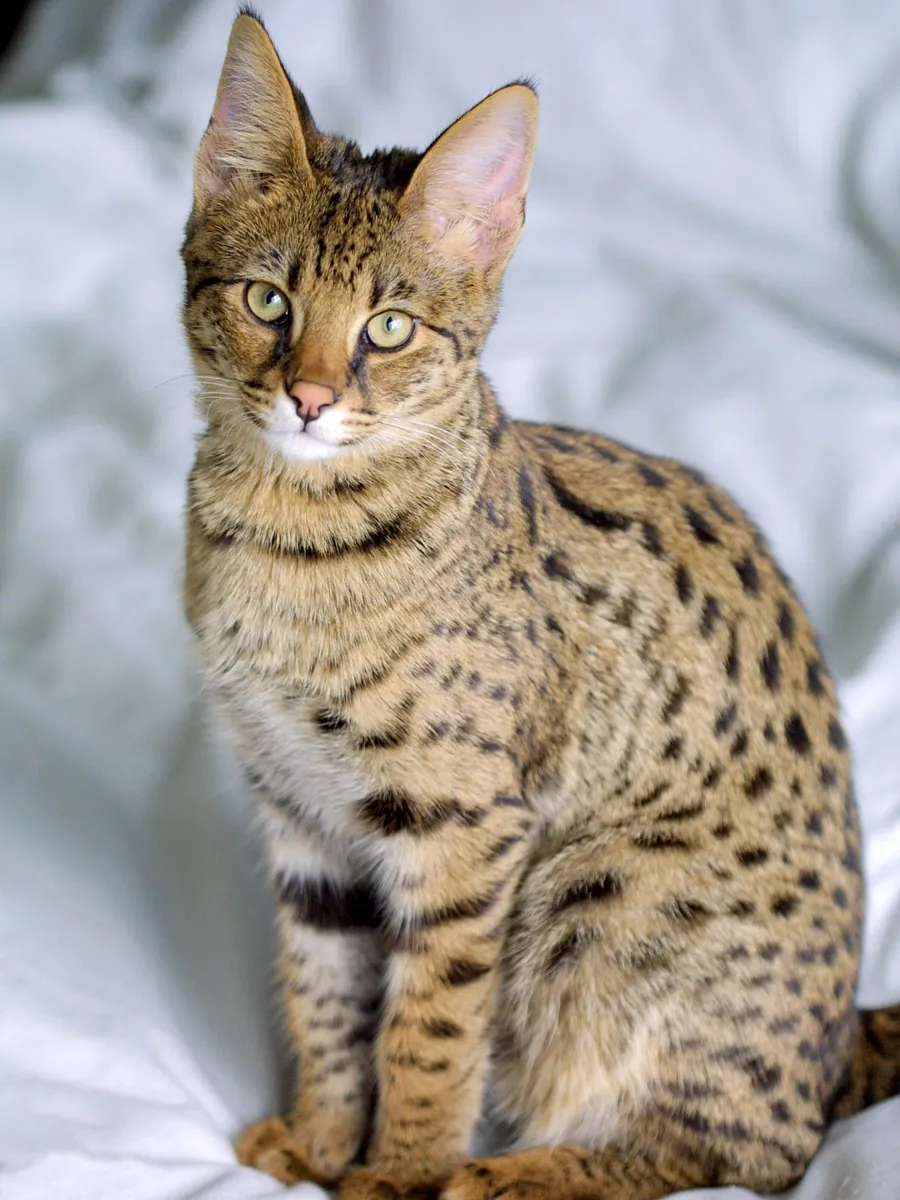
Not for sale.
How big they are. The Queensland Government says a Savannah cat is much larger than a domestic cat.
- It says first-generation males weigh 8 to 11 kg and stand 40 to 45 cm at the shoulder. Fourth and fifth-generation males can weigh 6.3 to 8.2 kg and stand 32 to 38 cm.
- The South Australian Government says one can weigh over 13.5 kg.
- A University of Sydney release puts a domestic cat at about 4 kg.
How they behave. Queensland’s assessment (Invasive animal risk assessment: Serval hybrids (PDF)) says they’re very active and can leap 2.5 metres high from a standing start. It also says early-generation or unsocialised cats can show wild-type behaviour, such as hissing and growling at people they don’t know.
What do F1, F2 and F5 mean?
Breeders give each generation an “F” number, which counts how many generations a cat is from its serval ancestor.
Queensland’s assessment (Invasive animal risk assessment: Serval hybrids (PDF)) gives each kitten’s parents:
| Generation | Mother | Father |
|---|---|---|
| F1 | A domestic cat | A serval |
| F2 | An F1 female | A domestic cat |
| F3 | An F2 female | A domestic cat |
| F4 | An F3 female | A domestic cat |
| F5 | An F4 female | An F4 male or a domestic cat |
Three points from the same assessment (Invasive animal risk assessment: Serval hybrids (PDF)) matter when you read an ad:
- Not a percentage. It says the F number doesn’t show how much serval is in a cat, because some breeders cross Savannah cats back to servals. It also says no one can scientifically measure the percentage of serval genes in a particular cat.
- Later generations breed more freely. It says males are usually sterile in the early generations and usually fully fertile from F5, while females are fertile from F1.
- Look-alikes are hard to tell apart. It says an untrained eye can’t easily tell some cat breeds from later-generation hybrids.
So “F5” or “5% serval” in an ad is just the seller’s word. In Australia it doesn’t change the law either.
Is a serval the same as a Savannah cat?
No. The serval is the wild parent species, and a Savannah cat is the cross.
Servals are tightly restricted too. The serval is on Part 2 of Australia’s live import list. Its entry reads: “Eligible non-commercial purpose only, excluding household pets.” Several states list it by name as well:
- New South Wales: dealings with a serval are banned except for exhibition or research (Biosecurity Act 2015, Schedule 3, Part 3).
- Western Australia: a prohibited declared pest (the state’s organism list).
- Victoria: a controlled pest animal, in the state’s declaration.
- Tasmania: restricted (special purpose) wildlife. Buying, selling or possessing one needs a licence or permit, and the fine for doing so without one is up to 100 penalty units.
- Queensland: the risk assessment (PDF) says servals and their hybrids can’t be kept without a permit, and that permits aren’t available for animals kept as pets.
Are Savannah cats legal in Australia?
Not to import, and not to keep or sell in the four states that ban them by name or by description. In Victoria, Tasmania, the Northern Territory and the ACT, the law turns on whether a Savannah counts as a cat.
The import rule
A live animal has to be on Australia’s live import list to be brought in. If it isn’t on the list, it can’t come in.
The list’s entry for the domestic cat now reads: Felis catus, “excluding any specimen of Felis catus derived from cross breeding with” a serval or a Savannah cat. A note adds that this excludes “any specimen with any genetic material derived from” the serval. We read the list as in force on 28 January 2026, the latest version on the Federal Register of Legislation.
How it got there, as the Federal Court’s judgments tell it:
- Before 2 August 2008, a fifth-generation (F5) Savannah was treated as a domestic cat, and could be imported subject to quarantine.
- In 2006 and 2007, breeders prepared to import F5 Savannah cats for breeding.
- On 16 June 2008, the environment minister began a review. A draft report went out for public comment, and drew about 549 written comments.
- On 30 July 2008, the minister made the change. It took effect on 2 August 2008. The environment department’s page lists the Savannah cat among the animals refused a place on the list, with the decision dated 30 July 2008.
- On 18 November 2011, the Federal Court dismissed the breeders’ challenge, with costs (Parker v Minister).
- On 29 June 2012, the Full Federal Court dismissed their appeal, also with costs (the appeal judgment).
What the government says now:
- The agriculture department’s cat import guide (updated 20 February 2026) says non-domestic cat hybrids can’t enter Australia. It names Savannah cats, “and any crossbred offspring derived from them”.
- The environment department’s Live Import List page (updated 24 September 2026) says a registry recognising a hybrid as a cat breed isn’t accepted as evidence that the animal isn’t a hybrid. It says the mule is the one hybrid on the list.
Can you import an F5 Savannah cat?
No. Breeders who wanted to import F5 cats brought the court cases. At the trial, they argued the rule was unreasonable because it treats an F5 the same as an F1 to F4 cat. The judge rejected that in 2011.
On appeal in 2012, the Full Federal Court said the exclusion “extends to any cat that is derived from cross-breeding” with a serval. It said the excluded class “is not limited to a specific generation of cross-bred cats”. So there’s no generation at which a Savannah cat becomes importable as a domestic cat.
The Act has one narrow exception: a permit for what the trial judge called “limited testing purposes”. It isn’t a way to bring in a pet.
What are the penalties for importing or keeping one?
These are the maximums in the national Environment Protection and Biodiversity Conservation Act 1999, as in force on 24 August 2026:
- Importing a live animal that isn’t on the list: up to 10 years in prison, 1,000 penalty units, or both (section 303EK). The environment department’s page puts the fine at up to $364,000 for a person and $1,820,000 for a company.
- Possessing an illegally imported animal, or the offspring of one: up to 5 years in prison, 1,000 penalty units, or both (section 303GN).
The possession offence has exceptions. One covers an animal whose imported ancestors all came in lawfully.
The environment department’s page says each case turns on the animal’s origin and the evidence. It says a species having been in Australia for a long time doesn’t by itself show it’s lawful. State law applies on top of that, wherever the cat came from.
The law in each state and territory
New South Wales, Queensland, South Australia and Western Australia ban them. In Victoria, Tasmania, the Northern Territory and the ACT, ask the government named below before you get one.
New South Wales
Banned. The Biosecurity Act 2015 prohibits any dealing with a non-native mammal unless the animal is on the Act’s list of exceptions (Schedule 3, Part 2).
The domestic cat is on that list, “except any specimen with any genetic material derived from” the serval. So serval crosses stay banned.
- What a dealing is: keeping, having, importing into the state, buying, selling, moving, breeding, displaying or releasing the animal, among other things (section 12).
- The penalty: a prohibited dealing is a category 2 offence. The maximum for a person is $220,000, plus $55,000 for each day the offence continues, or $1,100,000 if a court finds it was committed negligently (sections 152 and 280).
- Who to tell: the Department of Primary Industries and Regional Development takes reports of suspected exotic animals through an online form.
We read the version of the Act in force from 10 June 2026.
Queensland
Banned. The Queensland Government says the Savannah cat is a prohibited invasive animal under the Biosecurity Act 2014 (page updated 24 September 2026). It says that you must not keep, move, give away, sell or release one, and you must report any sighting of one to Biosecurity Queensland straight away.
- How it’s written: the regulation under the Act makes every mammal that isn’t native to Australia prohibited matter, apart from restricted matter and a list of named animals. That list has the domestic cat and the Bengal cross. It has no serval cross (Biosecurity Regulation 2016, Schedule 1, Part 4).
- The penalty: the Biosecurity Act 2014’s maximum for dealing with prohibited matter is 1,000 penalty units or 1 year in prison (section 37). Failing to report prohibited matter carries the same maximum (section 36).
- Who to tell: Biosecurity Queensland on 13 25 23.
We read the Act and the regulation as in force from 27 April 2026.
South Australia
Banned. The South Australian Government says it’s illegal to keep, transport, sell or release Savannah cats in South Australia, under the Landscape South Australia Act 2019.
- The penalty: under the Landscape South Australia Act 2019, the maximum for keeping or selling a declared animal depends on the category it’s declared in: $12,500 for Category 3, $25,000 or 6 months in prison for Category 2, and $60,000 or 1 year in prison for Category 1 (sections 187 and 188).
- Releasing one: up to $125,000 or 2 years in prison (section 189).
- Who to tell: the Pest Alert Hotline on 1800 084 881. The government asks people to report all suspected sightings.
We read the version of the Act dated 25 November 2023, the current one on the state’s legislation site.
Western Australia
Banned without a permit. The state’s organism list has the Savannah cat as a declared pest in its prohibited category, for the whole state, with a keeping category of “prohibited”.
The department says prohibited organisms may be imported and kept only under permits. For some species, it says, permits may be available only to research organisations or similarly secure institutions. Its legend (Western Australian Organism List) says an animal in that keeping category can be kept only under a permit for public display and education, or genuine scientific research, by entities the state approves.
- Keeping one: a fine of $50,000 (Biosecurity and Agriculture Management Act 2007, section 23).
- Supplying one to a person in the state without a permit: a fine of $20,000 (Biosecurity and Agriculture Management Regulations 2013, regulation 25; section 24 of the Act).
- Advertising one for supply: a fine of $5,000, unless the ad carries one of two set statements (regulation 26).
- Who to ask: the Pest and Disease Information Service, on (08) 9368 3080.
The Biosecurity and Agriculture Management Act 2007 sets higher penalties for any “high impact organism” a regulation prescribes. Ask the Pest and Disease Information Service whether the Savannah cat is one.
We read the Act as in force from 28 May 2026 and the 2013 Regulations (Biosecurity and Agriculture Management Regulations 2013) as in force from 19 March 2026.
Victoria
A prohibited pest animal, unless it counts as a domestic cat. Victoria declares pest animals under the Catchment and Land Protection Act 1994. Its declared pest animal list makes the whole cat family (Felidae) a prohibited pest animal, with three exceptions:
- the domestic cat
- the cross of a domestic cat and an Asian leopard cat (the Bengal)
- the wild cats on its controlled list, which includes the serval.
The declaration lists the Bengal cross as its own exception, separate from the domestic cat. Ask Agriculture Victoria whether a Savannah counts as a domestic cat before you rely on this.
- The penalty: bringing into Victoria, keeping or selling a prohibited pest animal carries up to 480 penalty units (section 75 of the Catchment and Land Protection Act 1994).
- Who to ask or tell: Agriculture Victoria says restricted pest animals in the wild, or being kept illegally, should be reported to its customer service centre on 136 186.
Tasmania
Needs permission to bring in, unless it counts as a cat. Here’s what Tasmania’s laws say about cats and wildlife:
- The Nature Conservation Act 2002 defines a cat as “a member of the species Felis catus”. Its definition of wildlife leaves out cats.
- A mammal that isn’t a cat, a dog or domestic stock can’t be brought in without the department secretary’s written permission (section 32).
- The serval itself is restricted wildlife. The Tasmanian Government says its risk assessors had serious concerns about servals breeding with domestic and feral cats.
Ask the department’s Wildlife Services on 03 6165 4305 before you assume a Savannah cat is allowed.
Northern Territory
A prohibited entrant, unless it counts as a cat. Under the Territory Parks and Wildlife Conservation Act 1976, a vertebrate animal that isn’t native to the Territory is a “prohibited entrant” unless the regulations say otherwise (section 52). The regulations exempt the cat, Felis catus.
If a Savannah doesn’t count as one, bringing one in or having one without a permit is an offence, with a maximum of 100 penalty units or 12 months in prison for a person (section 67B). The Territory Government’s page says permit applications are assessed case by case. Ask Parks and Wildlife before you assume one is allowed.
ACT
Needs a licence, unless it counts as a domestic cat. Under the Nature Conservation Act 2014, it’s an offence to keep, sell or bring into the ACT an animal that isn’t an “exempt animal”, unless a licence allows it.
The maximum is 100 penalty units, 1 year in prison, or both (sections 133, 134 and 136). The Conservator’s licensing guidelines say licences won’t be issued for non-native mammals other than ferrets.
The exempt list, remade on 11 May 2026, includes “Cat (Domestic), Felis catus”. So it turns on whether a Savannah counts as a domestic cat.
The ACT’s declarations of pests and of prohibited biosecurity matter (Biosecurity Act 2023) don’t list a cat, a serval or a serval cross. Ask the ACT Government before you assume one is allowed.
Why are Savannah cats banned here?
To protect native wildlife. The concern is that a bigger cat would join Australia’s feral cat population.
The government’s 2008 assessment. The Federal Court summarised the report the minister acted on. The report found an extreme risk that Savannah cats would become part of Australia’s feral cat population and become a pest, and said they had the potential to affect native wildlife differently, and more, than the domestic cats already here.
The 2019 study. Professor Chris Dickman and two colleagues tested the decision in a paper in the journal Animals.
It estimated Savannah cats would:
- add at least 28 native mammal species to the 168 already known to be susceptible to predation by domestic cats
- put 91% of Australia’s land mammal species that can’t fly at some risk of predation, and 93% of its threatened mammal species.
The University of Sydney’s release about the study, dated 30 October 2019, uses different figures. It says domestic cats already prey on at least 151 native mammal species, and Savannah cats would have put another 29 under threat. The paper gives 151 too, as the number of native mammal species domestic cats are known to prey on.
The release adds that Savannah cats could have roamed across 97% of the country, and can hunt prey twice the size a domestic cat can. The study assumed Savannah cats would hunt prey similar to what both parent species hunt. Its authors say the 2008 decision was a precaution, because there was no direct evidence then of the cats’ effect on prey.
State governments. The Queensland and South Australian governments (Business Queensland and PIRSA) both say Savannah cats could breed with feral cats and produce bigger ones.
The South Australian Government says those hybrids could prey on larger native animals that feral cats haven’t been able to take. It adds that Australia has no native cat species.
What are the welfare concerns?
The RSPCA opposes the cross itself. Its breeding policy, adopted on 8 April 2024, opposes crossing wild species with domestic animals to make new breeds of companion animal, “due to the significant problems associated with the care and management of such animals” (RSPCA Policy A6, clause 6.10).
Kittens can be born early. Queensland’s risk assessment (PDF) says a pregnancy lasts 63 days in a domestic cat and 73 days in a serval, so early-generation Savannah kittens are often born prematurely.
Some end up surrendered or released. The University of Sydney release says wildlife shelters in the United States report that Savannah cats are often surrendered or released because of serval-like behaviour. That can include aggression towards people and other pets, and spraying urine to mark territory. It says they can be hard to contain, and they often learn how to open doors.
Health is little studied. Queensland’s assessment (Invasive animal risk assessment: Serval hybrids (PDF)) says health problems specific to Savannah cats are unknown, because the cross is so recent.
How much does a Savannah cat cost?
We don’t give a price. None can be imported as a pet, and four states ban selling them, so treat an ad for one as a warning sign.
A price in an ad doesn’t show the cat exists, or that it’s legal to buy. For what kittens of domestic breeds cost, see what puppies and kittens cost.
What should you do if you see a Savannah cat advertised?
Treat it as a warning sign. It may be an illegal animal, a scam, or another cat sold under the wrong name.
Why it fits a scam. A Scamwatch alert from 30 April 2013 describes the pattern for puppies: an ad for an animal that doesn’t exist, photos, then fees for transport, customs or medical costs before delivery.
It says a scammer who claims the animal is overseas may blame customs or quarantine and ask for more money. That suits a cat no one can lawfully import. See how to spot a pet scam.
What to do:
- Don’t pay anything, including a deposit. If you’ve already paid, call your bank now, then read what to do next.
- Report the ad to the site it’s on.
- Tell the government agency for that state. For the ACT, ask Access Canberra. For the others, each government’s own page gives these contacts, for reports or questions:
- Queensland: Biosecurity Queensland, 13 25 23
- South Australia: Pest Alert Hotline, 1800 084 881
- Victoria: Agriculture Victoria, 136 186
- New South Wales: the online form of the Department of Primary Industries and Regional Development
- Western Australia: the department’s Pest and Disease Information Service, on (08) 9368 3080
- Tasmania: Wildlife Services, 03 6165 4305
- Northern Territory: Parks and Wildlife’s wildlife operations, 0401 115 702, the 24-hour number on the Territory Government’s wildlife crime page
- If you think a cat was brought in from overseas, the agriculture department takes confidential reports of suspected breaches of biosecurity law on its Redline, 1800 803 006.
If an ad for one appears on our site, email info@petsales.net.au.
Why don’t we list Savannah cats?
We don’t list animals the law says can’t be imported, kept or sold. Our Listing Rules put it this way, under what can’t be listed: “Savannah cats and any cat with serval ancestry, at any generation. They can’t be brought into Australia, and New South Wales, Queensland, South Australia and Western Australia ban keeping or selling them.”
The rule applies in every state and territory. A listing on a national site can be seen by buyers in the states that ban them.
Which spotted cats can you own instead?
These are domestic breeds with patterned coats. None is a stand-in for a Savannah, and we don’t rank breeds. A coat tells you nothing about a cat’s health or nature, so ask each breeder about both.
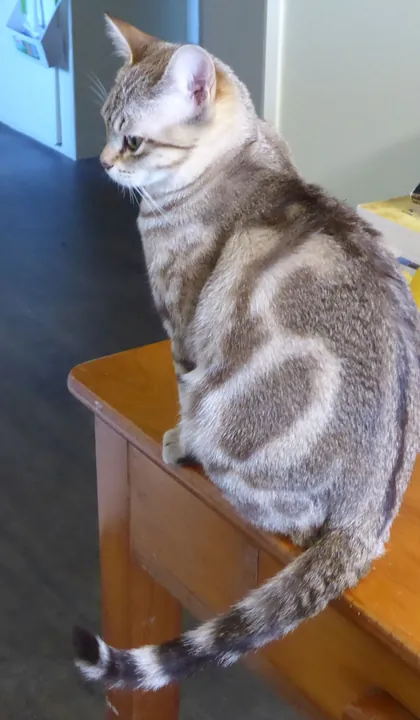
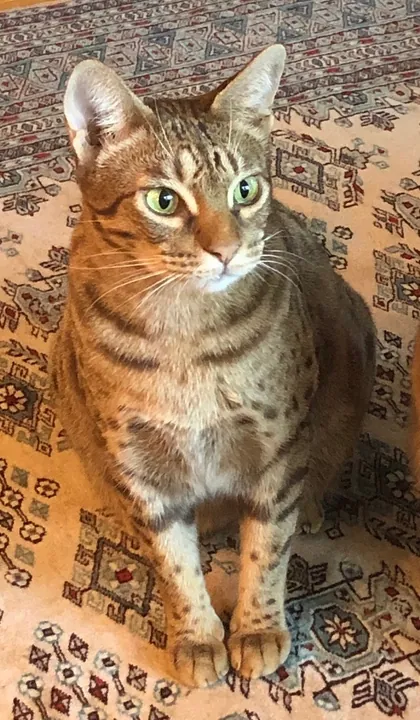
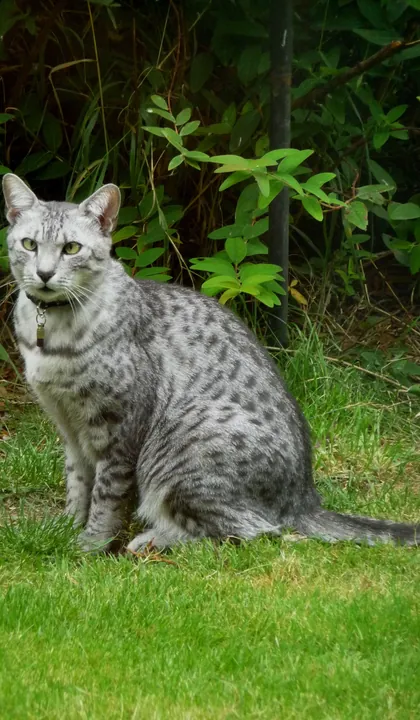
Not for sale. Photo: Lil Shepherd, CC BY 2.0, cropped.

- Australian Mist. The Australian Cat Federation’s Australian Mist standard (PDF) describes a cat of moderate type, “with no tendency to extremes”, in a spotted or marbled tabby pattern. A UK registry, the Governing Council of the Cat Fancy, says it was developed in Australia from the mid-1970s, from Burmese, Abyssinian and domestic shorthair cats.
- Ocicat. The Australian Cat Federation’s Ocicat standard (PDF) describes a medium to medium-large, well-spotted cat noted for its “wild” appearance. The UK registry (Governing Council of the Cat Fancy) says no wild cat was used in its bloodlines: it came from Siamese and Abyssinian crosses.
- Egyptian Mau. The Australian Cat Federation’s Egyptian Mau standard (PDF) calls it a natural domesticated breed of spotted cat, with randomly spotted markings on the body. The UK registry (Governing Council of the Cat Fancy) says it comes from the street cats of Egypt.
- A rescue cat. Ask rescue groups about spotted and tabby cats too. See rescue and adoption.
Looking for a kitten? See kittens for sale or all cats. Listings open soon.
What about Bengal cats?
A Bengal is a different cross: a domestic cat and an Asian leopard cat. The import rule for Bengals has changed too.
- The old rule. The environment department says that since 2013, importers who could prove their Bengal was five generations from the leopard cat had been given exemptions.
- The change. On 10 December 2024 it announced that the policy would change from 1 March 2025, and that Bengals would be treated like any other animal under the national environment law. It said imported cats under the exemption had often had a high percentage of leopard cat genes.
- Where it stands. The department’s Live Import List page (updated 24 September 2026) says the fifth-generation exemption no longer applies. The agriculture department’s cat import guide says: “As of 1 March 2026, Bengal cats are no longer permitted to enter Australia.”
- What’s pending. The environment department’s page says an application has been received to add the Bengal cat to the live import list, and that the Minister for the Environment and Water will make the final decision.
That’s a rule about importing. This page doesn’t cover keeping or selling Bengals already in Australia.
Two state laws we read make room for the Bengal: Victoria’s declaration (Consolidated lists of declared noxious weeds and pest animals) leaves the Bengal cross off its prohibited list, and Queensland’s Biosecurity Act says “cat” includes a Bengal cat. See Bengal cats.
Before you pay for any cat
- Meet the seller and the cat in person before you pay anything, including a deposit. For a breeder’s kitten, meet its mother too. A video is a first look, not a visit.
- Never pay a seller for transport, crates or insurance. These are fees scammers often ask for.
- Be wary of a rare cat at any price. A fair price doesn’t prove an ad is real.
Pet Sales Australia doesn’t hold or protect payments between buyers and sellers. You pay the seller directly. We can’t get your money back.