Scottish Fold and Highland Fold cats: why we don’t list them
Pet Sales Australia doesn’t list Scottish Fold or Highland Fold cats. The gene that folds their ears also affects cartilage and bone in the rest of the body.
The short version
- The health problem. The RSPCA says every cat with folded ears is affected to some degree, and that there’s no cure.
- The Highland Fold is the long-haired Scottish Fold. Some cat bodies call it the Scottish Fold Longhair.
- The rules are about breeding and selling. Victoria goes furthest: it’s an offence there to let a cat with the fold breed outside the state’s code, or to sell or pass one on without telling the new owner about the defect first.
- South Australia and the ACT have general rules against breeding from animals that carry, or are likely to pass on, a serious inherited fault. An ACT code of practice for cats lists the Scottish Fold by name.
- Pet Sales Australia doesn’t list Scottish Fold or Highland Fold cats, in any state or territory.
- Offered a Fold kitten? In Victoria, the seller has to tell you about the defect first. Ask to see each parent’s DNA result for the fold variant. What else to ask.
- Like the round face and plush coat? Other cats to look at.
- This is general information, not legal or veterinary advice. We link each source where we use it.
Jump to the health problem, the law, why we don’t list them or if you already own one.
At a glance
| Scottish Fold and Highland Fold | |
|---|---|
| What it is | A cat whose ears fold forward and down. Short coat: Scottish Fold. Long coat: Highland Fold, also called Scottish Fold Longhair |
| What folds the ears | A variant in one gene, TRPV4, which affects how the cartilage forms |
| The health problem | Osteochondrodysplasia: bone and cartilage that don’t develop normally, leading to arthritis. The RSPCA says there’s no cure |
| Which cats are affected | The RSPCA says every cat with folded ears is, to varying degrees. It says straight-eared kittens from the same litters don’t carry the variant |
| Cat bodies | Recognised by the Australian Cat Federation (PDF) and the Co-ordinating Cat Council of Australia (PDF). Refused by the UK’s Governing Council of the Cat Fancy and by FIFe (PDF) |
| The law | Breeding is restricted in Victoria, and a seller there must tell the buyer about the defect. South Australia and the ACT have general inherited-fault breeding rules |
| On Pet Sales Australia | Can’t be listed, in any state or territory |
We read the Acts, codes and standards named on this page on 10 and 11 October 2026. Sources are linked below.
What is a Scottish Fold cat?
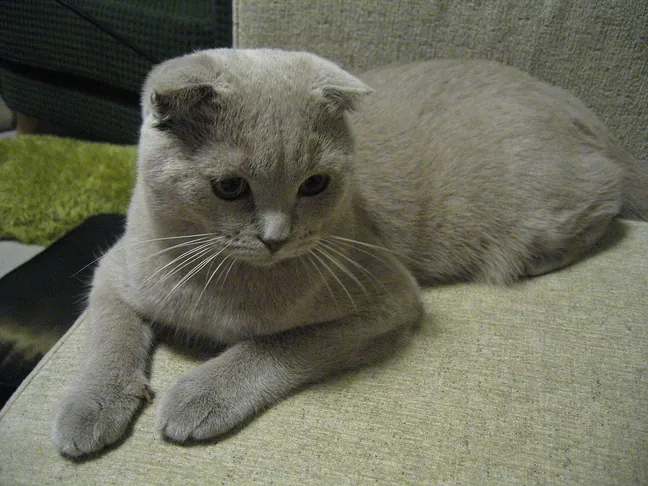
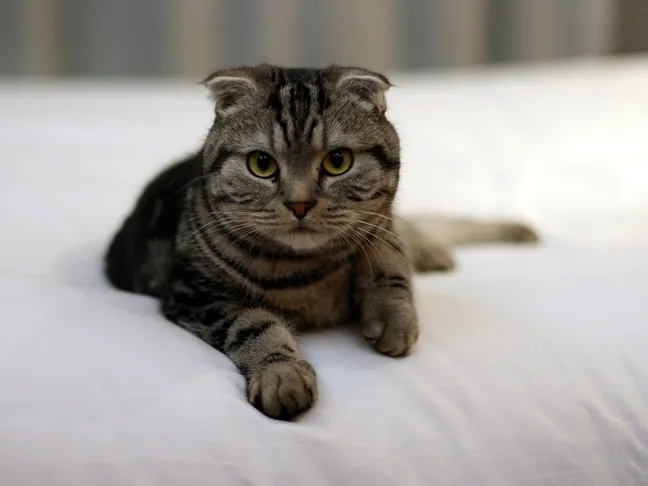
A Scottish Fold is a cat whose ears fold forward and down, so they sit against the head like a cap. The RSPCA says the fold comes from a natural genetic mutation, first seen in a farm kitten in Scotland in 1961.
The Cat Fanciers’ Association (CFA), a US cat registry, tells the story. A shepherd, William Ross, saw a white cat called Susie on a farm in the Tayside region. Her daughter became the first breeding queen.
The Australian Cat Federation’s breed standard (PDF) says the breed was established with crosses to British Shorthairs and domestic cats.
The breed standards (Australian Cat Federation (PDF)) describe a medium-sized, rounded cat: a round head, large round eyes and small, tightly folded ears. The short coat is dense and plush.
Kittens aren’t born with folded ears. The CFA says the ears don’t begin to fold until 3 or 4 weeks of age.
Some kittens in a Fold litter keep straight ears. Cat bodies register those under another name, such as Scottish Shorthair in Australia or Scottish Straight in other countries.

What is a Highland Fold cat?
A Highland Fold is a long-haired Scottish Fold, with the same folded ears. Only the coat differs.
Which name you see depends on the cat body:
- Highland Fold is the name the World Cat Federation (PDF) uses. Its breed standard, updated 13 August 2023, is titled “Highland Fold”.
- Scottish Fold Longhair is the name two Australian cat bodies use. The Australian Cat Federation (ACF) (PDF) and the Co-ordinating Cat Council of Australia (CCCA) (PDF) each have one standard that covers the short-haired and the long-haired cat.
- The CFA has a Longhair division of the Scottish Fold, and The International Cat Association (TICA) lists a Scottish Fold Longhair.
The ACF standard (PDF) describes the long coat as medium to long, with a full coat on the face and body preferred, and breeches, a tail plume, toe tufts and ear furnishings. Everything here about Scottish Folds applies to Highland Folds too: the health problem, the law and our rule.
What makes the ears fold?
One gene.
A 2016 study in the journal Osteoarthritis and Cartilage compared DNA from 44 Scottish Folds and 54 other cats. It traced the folded ear to a single change in a gene called TRPV4. The researchers didn’t find that change in 648 unaffected cats.
The RSPCA explains what the variant does: it causes a defect in how cartilage forms. Normally the cartilage holds the ear in its usual shape, but in a Fold it can’t, so the ear folds.
Cartilage isn’t only in the ears. The RSPCA says the same defect causes other deformities throughout the body.
The trait is dominant. A cat needs only one copy of the variant, from one parent, to have folded ears. So a Fold mated with a straight-eared cat still has folded-ear kittens. The RSPCA says that’s about half the litter.
What health problems do Folds have?
The condition is called osteochondrodysplasia, or Scottish Fold disease. The word means bone and cartilage that don’t develop normally.
The RSPCA says it causes serious abnormalities in joints and bone growth. These lead to:
- arthritis, with painful, swollen joints
- a short, abnormally thick tail that doesn’t bend
- spinal abnormalities
- short, stiff legs.
It says affected cats can be lame, walk with an abnormal gait, be reluctant to walk or jump, or even become completely crippled. The disease can show up on x-rays from as young as 7 weeks of age, and it gets worse as time goes on.
How badly a cat is affected varies. International Cat Care, a UK cat welfare charity, says some cats may show no signs of pain, others have minor signs, and the signs may worsen over time.
Do all Scottish Folds get it?
The sources agree that the gene affects the bones. They differ on how many cats suffer for it.
- The RSPCA says all Scottish Folds with folded ears are affected, and that cats with one copy of the variant develop it in varying severity.
- A 1999 Australian study in the Australian Veterinary Journal described 10 affected cats. All nine with a known pedigree reportedly came from a Fold mated with a normal-eared cat. The authors concluded all Scottish Folds had the condition to some degree.
- A 2008 report in the Journal of Small Animal Practice looked at three generations of cats bred fold to normal ear. Every folded-ear cat had bone changes in the lower parts of its legs. Severity differed from cat to cat, and cats with mild disease showed no signs.
- A 2021 study in Human Genetics had four reviewers score x-rays of 22 cats without knowing which had folded ears. All 10 folded-ear cats had one copy of the variant. On average they scored worse than the 12 straight-eared cats, but their signs were much milder than earlier studies had reported. The authors note that early work found severe changes in cats with two copies.
- A 2023 Australian study in BMC Veterinary Research searched the vet records of 1,131 Scottish Folds seen at clinics in New South Wales, Queensland and Victoria between 1992 and 2018. Twelve had a recorded diagnosis (1.1%). Another 64 had signs that suggested it. Diagnosed cats were generally under 30 months old. The authors called that a relatively low rate of diagnosed disease, said cases may have been missed, and asked for more research.
Taken together, the sources point to bone changes in cats with folded ears, and to pain or lameness in some of them. No source we read says how to tell which kitten will be which.
Is there a treatment?
There’s no cure. The RSPCA says cats that develop arthritis need long-term pain relief, which can have side effects. In a small number of cases, surgery or radiotherapy has slowed the disease. It says cats with severe disease often need to be put down, sometimes early in life.
Can a Scottish Fold be bred healthy?
Not if it has folded ears, on the evidence we read. The fold is the gene’s effect on cartilage, so a cat can’t have one without the other.
What breeders can do is avoid the worst form. Cat bodies that register Folds have rules against mating two Folds:
- the ACF’s breeding rules (PDF), updated June 2026, say “Scottish Fold to Scottish Fold mating is not permitted”
- the World Cat Federation’s standard (PDF) says the same of its Scottish Fold and Highland Fold.
A Fold is mated with a straight-eared cat instead, so no kitten gets two copies of the variant. The CFA says responsible breeders do this “to minimize arthritic and bone conditions”.
That leaves about half the litter with folded ears and one copy, and half with straight ears and none. The studies above found bone changes in one-copy cats, from mild to severe. A DNA test can show whether a cat has the variant. We found no source that says a test result predicts how a one-copy cat will fare.
The welfare bodies go further than the breed bodies:
- The RSPCA says the condition is preventable by not breeding from any cat with folded ears. It doesn’t support breeding Scottish Folds, including mating a Fold with a straight-eared cat. Its Smart Kitten and Cat Buyer’s Guide (PDF) says breeds such as Scottish Folds should not be bred.
- A cat charity. International Cat Care says it’s unethical to continue to breed cats with a mutation known to cause significant, painful disease.
The breed bodies that register Folds warn about the gene too. The ACF’s rules (PDF) say it “can have serious health and welfare complications”. The Australian Cat Federation (PDF) and Co-ordinating Cat Council of Australia (PDF) standards fault a kinked, shortened or inflexible tail, and say the legs must show no thickness, stiffness or lack of mobility.
Who recognises the Scottish Fold?
Some do and some refuse. Each row is from the body’s own page or rules.
| Cat body | Its position |
|---|---|
| Australian Cat Federation (ACF) (PDF) | Recognises the Scottish Fold, long-haired and short-haired. Standard amended November 2025. Fold-to-fold matings aren’t permitted (PDF). Straight-eared kittens are a separate breed, the Scottish Shorthair or Longhair |
| Co-ordinating Cat Council of Australia (CCCA) (PDF) | Has a standard for the Scottish Fold Shorthair and Longhair, with an issue date of February 2025. Straight-eared kittens are registered as Scottish Shorthair |
| Cat Fanciers’ Association (CFA) | Recognises it. Championship status for short-haired Folds since 1978 and long-haired since 1992. Straight-eared cats accepted in 2022 |
| The International Cat Association (TICA) | Lists Scottish Fold, Scottish Fold Longhair, Scottish Straight and Scottish Straight Longhair among its breeds |
| World Cat Federation (WCF) (PDF) | Has a standard for the long-haired cat under the name Highland Fold. Fold-to-fold matings aren’t permitted |
| Governing Council of the Cat Fancy (GCCF), UK | Doesn’t recognise it. Its list of unrecognised breeds says: “Ineligible. Known serious health problems (osteochondrodysplasia).” |
| Fédération Internationale Féline (FIFe) | Its breeding and registration rules (PDF), issued 1 July 2026, say it won’t register or recognise any breed that shows osteochondrodysplasia as a breed characteristic. The rules give the Scottish Fold as the example |
The RSPCA says the breed was excluded from the Cat Fancy of Great Britain in 1974 because of the deformities, and US breeders carried on. If you’re dealing with a state cat body, such as those in Victoria, New South Wales or Queensland, ask it for its own rule.
Are Scottish Fold cats legal in Australia?
The rules are about breeding and, in Victoria, about what a seller must tell a buyer. They differ by state.
The federal government’s cat import guide names hybrid cats, such as Savannahs and Bengals, as cats that can’t be brought into Australia.
Is the Scottish Fold banned in Victoria?
No. Victoria restricts breeding, and anyone who knows of the defect, or is reckless about it, must tell the new owner before they sell or pass one on. Victoria’s other rules still apply: see what a Victorian ad must show.
What the Act says. The Prevention of Cruelty to Animals Act 1986 has a schedule of diseases caused by heritable defects. For cats it lists three, and one is “Folded ears due to osteochondrodysplasia”. Under section 15C of the Act:
- a person must not intentionally or recklessly allow an animal with a heritable defect to breed
- a person who knows an animal has a heritable defect, or is reckless about it, must not “sell or dispose of” it without first advising the new owner that it has the defect.
Each offence carries up to 60 penalty units for a person and 300 for a company. At the 2026 to 2027 penalty unit of $209.10, that’s up to $12,546 for a person and $62,730 for a company.
What the code says. The Code of Practice for the Breeding of Animals with Heritable Defects that Cause Disease sets out when breeding isn’t treated as that offence. It says breeding in a program that conforms to the code isn’t considered reckless or intentional.
The code names “Folded ears associated with osteochondrodystrophy (Scottish Folds)” as a dominant disease. For those, it says:
- an animal whose disease causes it suffering and disability must not be used for breeding
- a cat with one copy of the gene may be mated with a cat that has none, but only under the code’s conditions and only if a vet approves it as suitable for breeding. The kittens must be tested. A vet must assess the affected ones, and they must be desexed unless an approved breeding program uses them
- mating two one-copy cats needs an approved breeding program
- a cat with two copies may be mated with a cat that has none only in an approved breeding program, and only to build up stock for breeding cats without the gene. It may never be mated with another cat that has the gene
- an affected animal must not be passed on without advice of its status. The advice must include its permanent identification, such as its microchip number, and a vet’s certificate with the diagnosis.
Approved breeding programs. Under the code (Code of Practice for the Breeding of Animals with Heritable Defects that Cause Disease), only an organisation the Minister has approved under the Domestic Animals Act 1994 can approve a breeding program for cats, and the breeder must be a member of it.
Ask the breeder which program they’re in, and who approved it.
The RSPCA puts the breeding rule more simply. It says affected Scottish Fold cats cannot be bred in Victoria under the code. The code’s own conditions are the ones above.
Agriculture Victoria says work is underway to replace the 1986 Act, on a page last updated in February 2023. This part of the law may change.
What the other states and territories say
| State or territory | What we found |
|---|---|
| Australian Capital Territory | The territory’s breeding standard (Animal Welfare (Breeding Standard) Determination 2015 (No 1)) says a person must not breed a litter from a dog or cat that “is exhibiting signs of or is known to carry a debilitating genetic fault”, or mate it with one that does. Under the Animal Welfare Act 1992 (section 15B), letting a female cat breed against the standard is an offence unless a vet has approved it in writing. The ACT’s Code of Practice for the Welfare of Cats, approved under the same Act in 2007, says “The deliberate breeding of malformed animals is unacceptable”, and lists the Scottish Fold among breeds that “may have genetic health problems associated with such breeding”. The code says its purpose is to give general guidelines. Ask the ACT Government whether the fold gene counts as a “debilitating genetic fault” |
| South Australia | The South Australian Standards and Guidelines for Breeding and Trading Companion Animals (PDF) say an owner must not allow a mating they know, or ought to know, has a high probability of producing a serious hereditary defect likely to harm the offspring’s health or welfare, unless an animal ethics committee approves it. Its examples are dog diseases |
| New South Wales | The breeding code for dogs and cats has a guideline, not an enforceable standard: where a breed has a recognised heritable disease and a test exists, a breeder should have the cat tested, give the result to the kitten’s new owner, and try not to make inherited disorders more common or more severe. The state’s animal welfare law is the Prevention of Cruelty to Animals Act 1979 |
| Queensland | The state’s compulsory breeding code, in the Animal Care and Protection Regulation 2023, covers dogs. It bars breeding from a dog with a harmful heritable condition without written approval. The state’s animal welfare law is the Animal Care and Protection Act 2001 |
| Western Australia | Under the Cat Act 2011 (section 35), only approved breeders may breed cats. The state’s animal welfare law is the Animal Welfare Act 2002 |
| Tasmania | Under the Cat Management Act 2009 (section 29), a person must be a registered breeder or hold a permit to breed a cat. The state’s animal welfare law is the Animal Welfare Act 1993 |
| Northern Territory | The territory’s animal welfare law is the Animal Protection Act 2018 |
We read each Act, code and standard above on 10 and 11 October 2026. Check with your state or territory’s animal welfare regulator, and your council, before you rely on this. South Australia’s rules may change: its legislation site says the Animal Welfare Act 1985 will be repealed by the Animal Welfare Act 2025.
Are Scottish Folds banned overseas?
In the Netherlands, yes, unless you already owned the cat. The Dutch Government says that from 1 January 2026 it’s prohibited to keep cats with folded ears as pets in the Netherlands. People who already owned one may keep it for life, and it must be microchipped.
Why doesn’t Pet Sales Australia list Scottish Fold or Highland Fold cats?
Because of the inherited health problem. Our Listing Rules say:
Munchkin cats and dwarf cats bred from them (such as Minuet, Bambino and Dwelf), Highland Fold and Scottish Fold cats, and crosses of any of them, because of inherited health problems.
That’s our rule in every state and territory, not only in Victoria. It covers kittens and adult cats, from breeders and owners alike.
The fold can’t be separated from the cartilage defect. The RSPCA says the disease is preventable by not breeding from folded-ear cats.
Once listings open, our checks stop a listing that picks a blocked breed, and our word check stops listing text that names one. They don’t prove a cat’s real breed, and other spellings can slip through.
If you see a Fold listed on Pet Sales Australia, use “Report This Listing” on the listing, or email info@petsales.net.au. See Report a Concern.
We still publish this guide, so anyone looking for the breed can read the health facts and the law first. The same rule covers Munchkin cats, because of a different inherited defect.
What if you already own a Scottish Fold?
Get your vet involved early.
The RSPCA’s advice to owners is to:
- be fully aware of the breed’s health and welfare problems
- talk to your vet about what to watch for and how you can help your cat
- have your cat desexed, so the problem isn’t passed on.
Watch for signs of pain. Here are the ones International Cat Care and the RSPCA list between them:
- reluctance to move, walk or play
- a stiff walk, or not curling up comfortably
- limping
- trouble jumping onto or off furniture
- hiding away, or eating less
- grooming less than usual
- toileting outside the litter tray, if climbing in hurts.
See your vet if you notice any of them. International Cat Care says a vet diagnoses it from the cat’s breed, a physical examination and x-rays.
Ask about pain relief. The RSPCA’s advice on arthritis in cats says arthritis hurts, and the longer pain goes untreated, the worse it becomes.
It lists anti-inflammatories, drugs for chronic pain and newer therapies, and says your vet can help you choose. Many joint supplements lack robust evidence, it says, and shouldn’t replace proven treatment.
Make home easier. Between them, the two bodies suggest:
- soft beds that are easy to reach, at floor level or with steps or a ramp
- food, water, litter and beds on one level
- a litter tray with a low side
- raised food and water bowls
- rugs on slippery floors
- help with grooming, and regular claw trims
- keeping your cat’s weight under control. The RSPCA says extra weight can make arthritis worse.
Plan for the cost. The RSPCA says Scottish Folds may need specialised vet care, and extra daily care on top of a cat’s usual needs.
If you can’t keep your cat, talk to a rescue group or your state’s RSPCA. See rescue and adoption. You can’t list a Fold on Pet Sales Australia. In Victoria, the law says you must tell the new owner about the defect before you sell or pass the cat on.
If you’re offered a Scottish Fold kitten
Know what you’re being offered. The RSPCA (PDF) says breeds such as Scottish Folds should not be bred. If you go ahead:
- In Victoria. The law (Prevention of Cruelty to Animals Act 1986) requires a seller who knows of the defect to advise you of it before the sale. The state’s code (Code of Practice for the Breeding of Animals with Heritable Defects that Cause Disease) says a breeder’s advice must come with the kitten’s microchip number and a vet’s certificate. Ask for both.
- The parents. Was either parent a Fold, or both? Ask to see each parent’s DNA result for the fold variant.
- Inherited disease. The RSPCA’s buyer’s guide (PDF) says to check whether a law or code on inherited diseases applies where you live, and to ask the breeder how they comply.
- Watch them move. The RSPCA’s guide tells buyers to check that the kittens and adult cats are moving freely and easily.
A low price or a rare colour tells you nothing about a kitten’s joints.
What to get instead of a Scottish Fold?
Like the round face and plush coat? Start here. We don’t rank breeds.
The RSPCA (PDF) says different breeds can be predisposed to different inherited disorders, so ask every breeder what they screen for, and ask to see the test results.
- British Shorthair. One of the breeds the Scottish Fold was developed with (Australian Cat Federation (PDF)). The GCCF, a UK registry that doesn’t recognise the Fold, names the British Shorthair as the alternative breed.
- Straight ears. The ACF (PDF) registers straight-eared Scottish cats as the Scottish Shorthair or Scottish Longhair. The RSPCA says these kittens don’t have the gene variant, and in the 2021 x-ray study none of the 12 straight-eared cats had it. Two things to know. They come from the same breeding programs as Folds: under the ACF’s rules, a Scottish Shorthair may only be bred with a Scottish Fold or another Scottish Shorthair. And straight ears on an ad are the seller’s word, so ask to see a DNA result. Our Listing Rules name the Scottish Fold and the Highland Fold, not the straight-eared Scottish breeds.
- A rescue cat. The RSPCA’s buyer’s guide (PDF) says to check your local RSPCA and other reputable rescue groups first. It says the RSPCA has many breeds of cats and kittens at any time, short-haired and long-haired. See rescue and adoption.
Looking for a kitten? See kittens for sale or all cats. Listings open soon.
Before you pay for any cat
- Meet the seller and the cat in person before you pay anything, including a deposit. For a breeder’s kitten, meet its mother too. A video is a first look, not a visit.
- Look up the seller’s number on the state’s own register, where there is one. Our source number page shows how.
- Read the warning signs. See how to spot a pet scam and how to spot a puppy or kitten farm.
- Read the RSPCA’s Smart Kitten and Cat Buyer’s Guide (PDF). It says a kitten shouldn’t leave its mother before it’s 8 weeks old and fully weaned.
Pet Sales Australia doesn’t hold or protect payments between buyers and sellers. You pay the seller directly. We can’t get your money back.