Munchkin cats: why we don’t list them
Pet Sales Australia doesn’t list Munchkin cats. The breed’s short legs come from a change in one gene, and our Listing Rules don’t allow the breed because of inherited health problems.
The short version
- What it is. A domestic cat with short legs and an ordinary-sized body. It isn’t a miniature cat.
- Health. The RSPCA says the short legs can restrict how a cat moves and may harm its joints. The registries that accept it say the legs don’t hold it back. The studies are small: they found bent or misaligned leg bones, and no long-term answers.
- Recognition. The International Cat Association and three Australian cat bodies have a standard or a listing for the breed. Two overseas bodies refuse it.
- The law. Victoria restricts breeding, and makes a seller tell the buyer. The ACT and South Australia have wider rules against breeding cats with serious genetic faults.
- On Pet Sales Australia. Munchkin cats, the dwarf cats bred from them, and their crosses can’t be listed.
- This is general information, not legal or veterinary advice. Ask a vet before you buy, and your state government or a lawyer about the law. We read our sources on 11 October 2026.
Jump to the health evidence, the law in each state or other cats to look at.
What is a Munchkin cat?
A Munchkin is a domestic cat with short legs. Its head and body are the size of an ordinary cat’s.
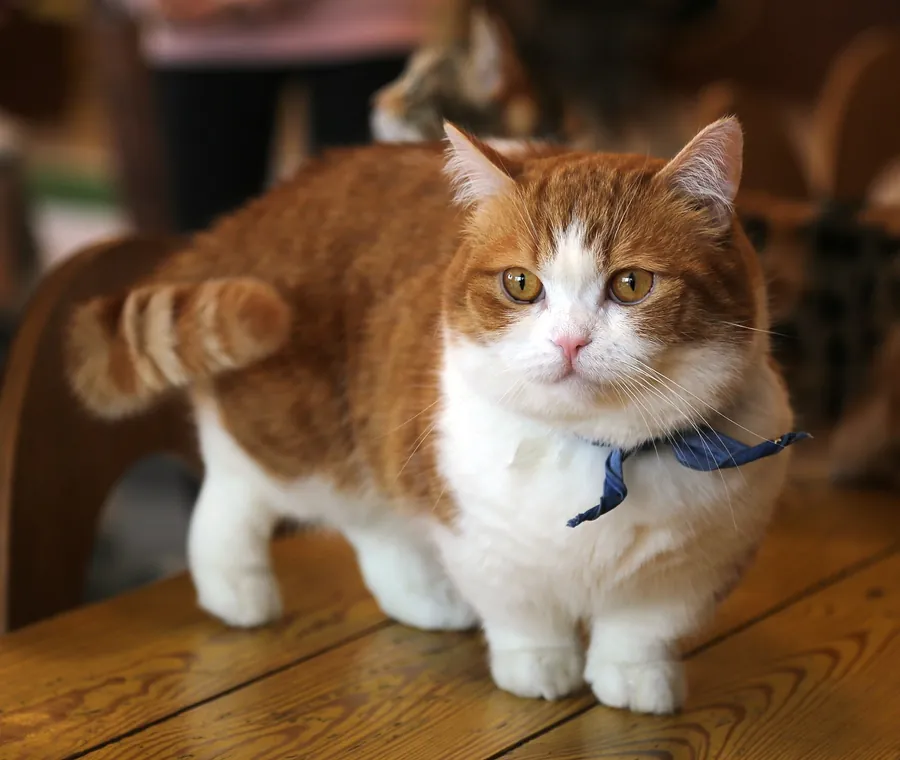
Not for sale.
- Size. The International Cat Association (TICA), which recognises the breed, calls it medium-sized. It gives adult weights of 5 to 7 pounds for females and 7 to 10 pounds for males (about 2.3 to 3.2 kg and 3.2 to 4.5 kg). It says the legs stay short while the body grows to an average adult size.
- Leg length. The Australian Cat Federation’s Munchkin standard (PDF) (amended November 2025) gives a desirable height of 17 to 21 cm at the withers (the top of the shoulders) for an adult. It says the legs shouldn’t be extremely short: a hand held sideways, four fingers wide, should fit under the chest.
- Coat. Short or long, in almost any colour or pattern.
- Where it’s from. TICA says short-legged cats have been recorded many times, and that today’s breed began with a short-legged female cat found in 1983. Her line was crossed with ordinary domestic cats. The name comes from the Munchkins in The Wizard of Oz.
- Not every kitten has short legs. Breeders call the short-legged cats “standard” Munchkins and their long-legged littermates “non-standard”.
Breeders also cross Munchkins with other breeds. A 2021 study says this dwarfism is now bred for in cats called Munchkin, Minuet and Napoleon (Veterinary and Comparative Orthopaedics and Traumatology). Our Listing Rules treat dwarf cats bred from Munchkins as Munchkins.
Why do Munchkin cats have short legs?
Because of a change in one gene, and a cat needs only one copy of it.
- One copy will do. TICA and the Australian Cat Federation both describe the cause as a natural mutation that is dominant. A short-legged cat can pass it to its kittens.
- The gene. In 2020, researchers at the University of Veterinary Medicine Hannover linked short legs to a change in a gene called UGDH (Struck and others, BMC Genetics). Every short-legged Munchkin they tested had one copy, and the long-legged ones had none. They called it the very likely cause. The same year, a team mapping the cat genome found three unrelated dwarf cats sharing a change that interrupts the same gene (Buckley and others, PLOS Genetics).
- Two copies. The Hannover team found no cat with two copies, and breeders told them that mating two short-legged Munchkins gave smaller litters. The researchers say this supports the idea that kittens with two copies die early in the womb. It’s a suggestion, not a tested finding.
- What it does. The long bones in the legs don’t grow to full length. The RSPCA calls this disproportionate dwarfism: the legs are short and the body isn’t. Victoria’s law (Prevention of Cruelty to Animals Act 1986) lists it for cats as “mutations causing aplasia or hypoplasia of any long bone”.
Do Munchkin cats have health problems?
Vets and welfare groups are worried. The registries that accept the breed aren’t. The research is thin, and it doesn’t settle the question.
What the RSPCA and vet bodies say
- The RSPCA. Its guide to exaggerated features in cats was updated on 9 January 2024. It lists the Munchkin among the main cat breeds in Australia that have significant welfare problems, are barred from breeding in at least one state or territory, or both. It says the Munchkin’s body shape has the potential to harm the cat’s health and welfare. It gives two examples: the cat’s movement may be restricted, which limits natural behaviour, and the way the legs develop could damage the joints. The RSPCA opposes breeding that produces physical features that harm an animal’s wellbeing (RSPCA Policy A6, clause 6.8.1, adopted 8 April 2024).
- Vets. The Australian Veterinary Association’s policy on genetic defects in domestic animals (re-ratified 20 July 2023) gives Munchkin dwarf cats as an example of a genetic defect that’s bred for on purpose. It says animals with a known genetic defect that could harm their welfare, or their offspring’s, must not be bred, other than in exceptional circumstances. It also says buyers should be told about the problem before a sale.
- A cat charity. A position statement from International Cat Care and its partner vet groups says breeding for extreme body shapes that impair welfare should be actively discouraged. Its list includes chondrodystrophy, a vet term for short-limbed dwarfism. It doesn’t name the Munchkin, and it isn’t dated.
- UFAW. A page on the Munchkin credited to UFAW (the Universities Federation for Animal Welfare) and compiled by two vets says the short legs reduce a cat’s ability to jump, and that abnormal loads on the joints may raise the risk of painful arthritis. It says the welfare effects hadn’t been studied in the scientific literature as far as it knew. It recommends that affected cats aren’t bred. The text carries a 2011 copyright date, and the page was updated on 6 May 2026.
What the registries that accept the breed say
- TICA says the gene shortens the legs’ long bones and nothing else. Its page says the spine isn’t affected, that Munchkins aren’t prone to arthritis, and that they move as well as other breeds as they age. It says they run and jump, though they may not reach a high shelf in one leap. Its standard says the long bones may bow slightly.
- The Australian Cat Federation’s standard (PDF) says the short legs don’t hamper mobility. The same standard tells judges to withhold a challenge (a show award) from a cat with an excessive dip behind the shoulders, a sway back or bowed front leg bones, or one that can’t bear weight or walk normally.
What the studies found
- Germany, 2020. The Hannover team took CT scans of a 4-year-old short-legged male. The long bones in his front and hind legs were shortened, and the bone shafts were thicker. One forearm bone was bent by about 43 degrees, and the joints at the elbow and wrist didn’t fit together evenly. His hind legs showed no twisting. The authors wrote that short-legged Munchkins have shorter legs without impaired health. Theirs was a gene study of one family and a wider group of cats, not a health survey.
- The US, 2021. A University of Missouri team x-rayed five pet dwarf cats that had the UGDH change, and compared them with normal cats (Anderson and others, Veterinary and Comparative Orthopaedics and Traumatology). Every leg had deformities: bones curved or angled differently, and forearm bones twisted outwards. They saw no arthritis on the x-rays. They wrote that the misalignment may make arthritis more likely later, and that it was too early to say what it does to joints over a cat’s life.
- The spine. The same team scanned two of the cats’ spines and found no disease. After the study, a 6-year-old dwarf cat came to their hospital with degenerated discs and a slipped disc. They wrote that they couldn’t rule out an effect on the discs, and that the question was still open.
What nobody knows yet
The Missouri study (Veterinary and Comparative Orthopaedics and Traumatology) looked at six cats from one breeder, and its authors called for long-term studies. Until those are done, we can’t tell you how many Munchkins develop arthritis or how long they live. No one, breeder or vet, can promise you that a Munchkin kitten will, or won’t, go on to have problems with its joints.
Is the Munchkin a recognised breed?
It depends on the registry. Recognition is each registry’s own call, and it doesn’t settle the health question or change the law. We read these sources on 11 October 2026.
| Body | Position | Source |
|---|---|---|
| The International Cat Association (TICA) | Recognises the Munchkin and Munchkin Longhair. The breed joined its new breed program in September 1994 and got championship status in May 2003 | TICA’s Munchkin page |
| Australian Cat Federation (ACF) | Has a Munchkin standard (longhair and shorthair), amended November 2025. Its rules allow crosses to domestic cats only, and keep Munchkins out of other breeds’ programs. It tells breeders to follow state law and points to Victoria’s code | ACF’s standard (PDF) and its breeding and registration rules (PDF) (June 2026) |
| Co-ordinating Cat Council of Australia (CCCA) | Publishes a Munchkin show standard, updated February 2025. It tells readers to check which breeds their own registering body recognises | CCCA’s breed standards |
| Australian National Cats (ANCATS) | Lists the Munchkin on its “Which breed is right for you?” page, along with the Napoleon and the Bambino | ANCATS’s breed page |
| Governing Council of the Cat Fancy (GCCF), a UK registry | Says it has no intention of recognising Munchkins or any other dwarf breed. It says that in 1991 it stated it would strongly discourage anyone from importing one | GCCF’s welfare page and its welfare statement (PDF) |
| FIFe (the Fédération Internationale Féline) | Its rules say it won’t register or recognise any breed with dwarfism as a breed feature, and give the Munchkin as the example. Such cats can’t be bred, registered or shown under its rules | FIFe’s Breeding and Registration Rules (PDF), issued 1 July 2026 |
Are Munchkin cats legal in Australia?
The rules are about breeding and selling, and they differ by state.
| State or territory | What the rules say |
|---|---|
| Victoria | The law lists the gene change as a disease caused by a heritable defect. It’s an offence to let an affected cat breed outside the state’s code, or to sell or pass one on without telling the new owner about the defect first. More below. |
| ACT | A mandatory breeding standard bars breeding from a cat that shows signs of, or is known to carry, a debilitating genetic fault. The ACT’s code of practice for cats, which is a guide, names the Munchkin. More below. |
| South Australia | The state’s breeding standards (PDF) bar a mating that’s highly likely to produce a serious hereditary defect, unless an animal ethics committee approves it. They apply to the owner of any dog or cat that’s bred or traded, and their examples are dog conditions. More below. |
| New South Wales | The state’s animal welfare law is the Prevention of Cruelty to Animals Act 1979. The breeding code (revised August 2021) covers heritable disease in a guideline, not an enforceable standard. |
| Queensland | The state’s compulsory welfare codes include one for breeding dogs. Its animal welfare law is the Animal Care and Protection Act 2001, and the breed-specific rules in the Animal Management (Cats and Dogs) Act 2008 are about dogs. |
| Western Australia | Under the Cat Act 2011, only an approved cat breeder may breed cats. For the state’s other animal welfare rules, see its adopted welfare codes. |
| Tasmania | Under the Cat Management Act 2009, only a registered breeder or a permit holder may breed cats. The Tasmanian Government explains the rules on its page on breeding and selling cats. |
| Northern Territory | The territory’s animal welfare law is the Animal Protection Act 2018. |
We read the Acts, codes and government pages named in each row on 11 October 2026. For your own cat, ask your state or territory government, your council or a lawyer.
Are Munchkin cats banned in Victoria?
No. Victoria restricts breeding, and anyone who knows of the defect, or is reckless about it, must tell the new owner before they sell or pass one on.
- In the Act. The Schedule to the Prevention of Cruelty to Animals Act 1986 lists three diseases in cats caused by heritable defects. One covers mutations that stop a long bone forming or growing fully. The state’s code on breeding animals with heritable defects names Munchkin cats as an example.
- Breeding. It’s an offence to intentionally or recklessly allow an animal with a listed heritable defect to breed (section 15C(1)). The maximum fine is 60 penalty units for a person and 300 for a company. That’s $12,546 and $62,730 until 30 June 2027.
- The conditions. The code says a person who breeds in a program that meets its principles isn’t considered to be breeding recklessly or intentionally under that section. It sorts cats by how many copies of the gene they have. Researchers found one copy in every short-legged Munchkin they tested. The code calls a cat like that a “carrier”, and treats it as affected. As we read the code:
- a short-legged cat may be mated with a cat that doesn’t have the gene only if a vet has approved it as suitable for breeding. The kittens must be tested. A vet must assess each affected kitten, and it must be desexed unless it’s going into an approved breeding program
- mating two short-legged cats is prohibited unless it’s part of an approved breeding program
- a cat whose defect causes it suffering and disability mustn’t be bred from at all
- the code also says animals mustn’t be used for breeding where the carrier state will produce lethal outcomes in their offspring.
- Two copies. The researchers say their findings support the idea that kittens with two copies die before birth. If that’s right, the code’s last point may rule out mating two short-legged cats altogether, even in an approved program.
- Approval. A breeding program needs approval. Only an organisation the Minister has approved under the Domestic Animals Act 1994 can approve one, and the breeder must be a member.
- Selling. It’s an offence to sell or dispose of an animal with the defect, knowing it has it or being reckless about that, without telling the new owner before the sale (section 15C(2)). The maximum fine is the same. The code says a breeder’s advice must include the animal’s permanent identification, such as its microchip number, and a vet certificate that ties the diagnosis to that identification.
- Suffering. The code says it’s a cruelty offence to permit an animal to suffer from a heritable disease.
The RSPCA’s guide puts the breeding rule more simply. It says affected cats can’t be bred in Victoria under the code. The code’s own conditions are the ones above.
Agriculture Victoria says work is underway to replace the 1986 Act, so the rules may change. Its page was last updated on 1 February 2023. For a definite answer about your own cat, call Agriculture Victoria on 136 186 and ask for Animal Welfare Victoria, or ask a lawyer.
The ACT
Two documents matter in the ACT, and both cover breeding.
- Mandatory rule. The Animal Welfare (Breeding Standard) Determination 2015 says a person must not breed a litter from a cat if the cat, or the animal it’s mated with, shows signs of or is known to carry a debilitating genetic fault. Under the Animal Welfare Act 1992 (section 15B), the person in charge of a female cat commits an offence if they let her breed in a way that breaks the standard. The maximum penalty is 50 penalty units. The offence doesn’t apply if a vet approved the breeding in writing.
- The cat code. The ACT’s code of practice for the welfare of cats (2007) says the deliberate breeding of malformed animals is unacceptable. It gives the Sphynx, Manx, Cymric, Munchkin and Scottish Fold as examples of breeds that may have genetic health problems. The code calls itself a guide.
South Australia
South Australia’s Standards and Guidelines for Breeding and Trading Companion Animals (PDF) (2017) apply to the owner of any dog or cat that’s bred or traded. The standards are the enforceable part, and one standard covers hereditary defects.
It says an owner who knows, or reasonably ought to know, that a mating has a high probability of producing a serious hereditary defect likely to harm the offspring’s health or welfare mustn’t allow it, unless an animal ethics committee approves it. The examples that standard gives are all conditions found in dogs.
These rules may change too. South Australia’s legislation site says the Animal Welfare Act 1985 and its regulations will be repealed by the Animal Welfare Act 2025. In January 2026 the state government said it expected a breeder licensing scheme, with new breeding standards, early the next year.
Bringing one into Australia
The federal government’s import guide for cats (updated 20 February 2026) bars cats crossed with wild cat species, such as Savannah cats. The Munchkin is a domestic cat, not a wild cat cross.
Why don’t we list Munchkin cats?
Because of inherited health problems. That’s the reason our Listing Rules give. The list of what can’t be listed includes:
Munchkin cats and dwarf cats bred from them (such as Minuet, Bambino and Dwelf), Highland Fold and Scottish Fold cats, and crosses of any of them, because of inherited health problems.
The feature that makes a Munchkin a Munchkin is the gene change. Victoria’s law (Prevention of Cruelty to Animals Act 1986) lists it as a disease caused by a heritable defect.
The RSPCA opposes breeding for physical features that harm an animal’s wellbeing. The Australian Veterinary Association’s policy gives Munchkin dwarf cats as an example of a genetic defect bred on purpose.
It’s our own rule, and it goes further than the laws above. It applies in every state and territory, to litters and adult cats, with no exceptions.
A breeder who follows Victoria’s code can’t list one here either. We don’t inspect animals or matings: our checks are of what sellers enter.
The rule is about the breed. The form doesn’t ask about leg length. Our Listing Rules also don’t allow dogs or cats sold as “teacup” or “micro”.
Once listings open, if a seller chooses Munchkin as the breed, the listing form stops the listing. Our word check will also stop listing text that names a Munchkin or a dwarf breed bred from one, such as “Munchkin kittens” or “Minuet kittens”. Other wording can slip through.
If you see a Munchkin on Pet Sales Australia, report it. Use “Report This Listing” on the listing, Report a Concern at the foot of any page, or email us at info@petsales.net.au.
Fold-eared cats are blocked for a similar reason. See Scottish Fold and Highland Fold cats.
What should you check if you see a Munchkin kitten advertised?
You may see Munchkins advertised on other sites. If you’re thinking about one, slow down and ask more than usual.
- Talk to your vet first. Ask what the short legs can mean for a cat’s joints and movement, and what care it might need. The RSPCA says it’s very hard to predict how much care a cat with exaggerated features will need, and that people with busy lives or limited income should think carefully about whether they could provide it.
- In Victoria, expect to be told before you buy. A seller who knows of the defect must tell you about it before the sale. The code (Code of Practice for the Breeding of Animals with Heritable Defects that Cause Disease) says a breeder’s advice must include the kitten’s microchip number and a vet certificate with the diagnosis. Walk away from a Victorian breeder who offers you neither.
- Ask which parent has short legs. If both do, ask how the mating met the law where the kittens were bred. In Victoria, the code prohibits that mating outside an approved breeding program.
- Check the law where you live. The RSPCA’s Smart Kitten and Cat Buyer’s Guide (PDF) says to check whether any law or code on inherited disease applies in your area, and to ask how the breeder complies.
- Watch the parents move, and see the vet reports. The RSPCA’s guide asks whether the kittens and adult cats are moving freely and easily. Look for the faults the Australian Cat Federation’s own standard (PDF) marks down: a dip behind the shoulders, a sway back, bowed front legs, or trouble walking. The RSPCA says a responsible breeder can show you copies of vet reports and screening tests.
- Visit where the kitten was born and raised, and meet its mother. A video is a first look, not a visit. The RSPCA calls it a big red flag if a breeder is reluctant to let you visit or wants to meet somewhere else, and says an offer of delivery should raise concern too.
- Don’t take a kitten home before it’s 8 weeks old. The RSPCA says 8 weeks is the minimum, and the kitten must be fully weaned.
- Don’t let the price decide. We can’t tell you what a Munchkin costs, because we don’t list them. A price tells you nothing about a cat’s joints, and a price that looks too good to be true is a scam warning sign.
What if you already own a Munchkin cat?
The rules on Munchkins are about breeding them and passing them on.
- Talk to your vet about the breed. The RSPCA’s advice to owners of cats with exaggerated features is to learn the breed’s specific problems and ask your vet what to watch for and how to help.
- Think about desexing. The RSPCA says desexing a cat whose exaggerated features cause welfare problems stops them being passed to another generation. In Victoria, it’s an offence to let a cat with the defect breed outside the code, so don’t let an undesexed Munchkin mate.
- If you need to rehome it, you can’t list it on Pet Sales Australia. Ask a rescue group, a shelter or your state’s RSPCA. In Victoria, tell the new owner about the defect before you hand the cat over: the law requires it.
What can you get instead of a Munchkin?
You can’t get a Munchkin’s short legs without the gene change, because that change is what makes them short.
If you want a small cat or a playful, people-loving one, these have ordinary legs. We don’t rank breeds.
The descriptions come from a UK cat registry, the Governing Council of the Cat Fancy. None of these cats is a substitute for a Munchkin.
- Singapura. The registry calls it the smallest breed of domestic cat, at 5 to 8 pounds (about 2.3 to 3.6 kg). It describes a playful, curious cat that doesn’t like long stretches alone. It also says the breed lacks genetic diversity, and names a condition that causes a form of anaemia and has a DNA test, so ask whether the parents were tested.
- Burmese. Described as playful, energetic and strongly people-oriented. The registry strongly recommends DNA testing all breeding Burmese for an inherited muscle condition. Ask the breeder to show you the results.
- Devon Rex. A medium-sized cat with a pixie-like look, described as playful, active and people-oriented. The registry names an inherited muscle disease with a DNA test, and says kneecap problems seem more common in the breed.
- Other cats. Think about a domestic shorthair or a rescue cat. The RSPCA’s buyer’s guide (PDF) suggests checking your local RSPCA and other reputable rescue groups first. It says they may have kittens and cats of particular breeds or types. See rescue and adoption.
The RSPCA (PDF) says different breeds can be prone to different inherited disorders. Ask each breeder what the parents were tested for, and see the results.
Looking for a kitten? See kittens for sale or all cats. Listings open soon.
Before you pay for any cat
- Meet the seller and the cat in person before you pay anything, including a deposit. For a breeder’s kitten, meet its mother too. A video is a first look, not a visit.
- In Victoria, check the seller’s source number. Almost every Victorian ad for a cat must show one, with the cat’s microchip number. Our source number page shows how to look it up.
- Read the warning signs. See how to spot a pet scam.
Pet Sales Australia doesn’t hold or protect payments between buyers and sellers. You pay the seller directly. We can’t get your money back.